
Zertifiziert gemäß
DIN EN ISO 13485:2016
DIN EN ISO 13485:2016
Rekombinante Blutgruppen-Antigene (rBGA)

Zur Spezifizierung von irregulären anti-Erythrozyten-Antikörpern
Der Nachweis von Antikörpern gegen erythrozytäre Antigene ist von zentraler Bedeutung für die prä- und post-transfusionelle Diagnostik zur optimalen Versorgung transfusionsbedürftiger Patienten. In Fällen, in denen der Patient zum Beispiel Antikörpergemische, Autoantikörper oder Alloantikörper gegen hochfrequente Blutgruppen-Antigene aufweist, kann ein eindeutiger Antikörper-Nachweis aufgrund durchgehend positiver oder sich überlagernder Reaktionen im Antikörper-Suchtest schwierig sein. Rekombinante Blutgruppen-Antigene (rBGA) von imusyn ermöglichen die spezifische Inhibition von Antikörpern im Gelkartentest und minimieren somit das Risiko inkompatibler Bluttransfusionen.

Ihr Ansprechpartner
Dr. Sabrina König
Telefon: +49 6173 6079 30
E-Mail: s.koenig@inno-train.de
Downloads
Flyer rBGA
Methode
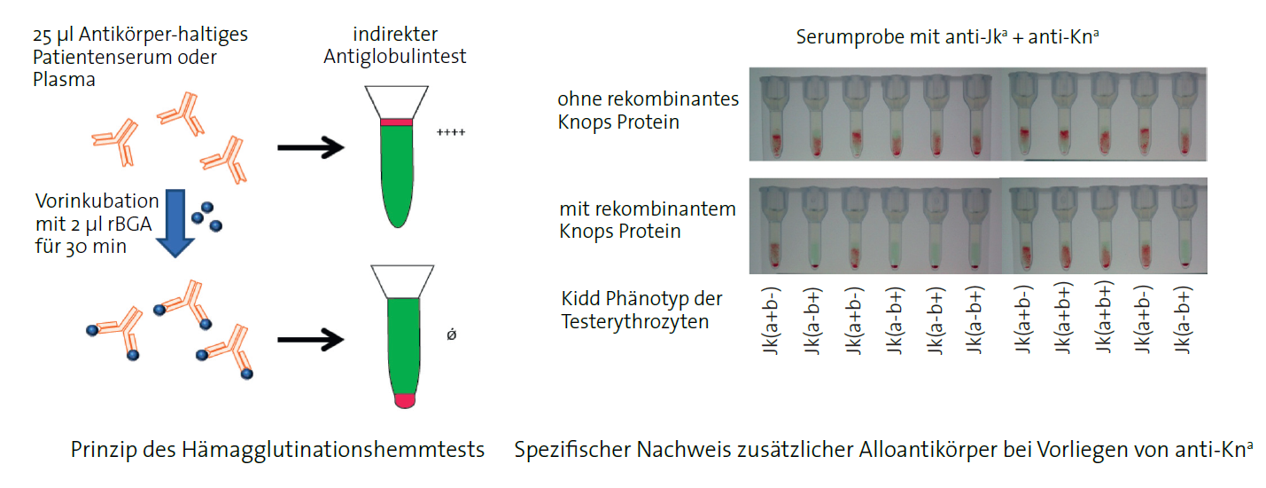
- Vorinkubation von 2 μl rBGA mit 25 μl Patientenserum: Neutralisierung spezifischer RBC Antikörper
- Serum kann für den indirekten Antiglobulintest mit gebräuchlichen Gelkarten-Systemen eingesetzt werden (Grifols DG® Gel Coombs, Bio-Rad ID-Card LISS/Coombs)
Vorteile und Eigenschaften der rBGA
Einfaches Testsystem
Direkte Antikörperidentifizierung
Antikörperdetektion und -identifizierung in einem Schritt
Einfache und schnelle Detektion und Identifizierung von Alloantikörpern gegen hochfrequente Blutgruppenantigene
Verbesserte Auflösung von Antikörpergemischen
Neutralisierung klinisch irrelevanter Antikörper gegen hochfrequente Antigene in der Verträglichkeitstestung
Schnellere und sicherere Versorgung immunisierter Patienten
Einfache Implementierung in die Routineserologie
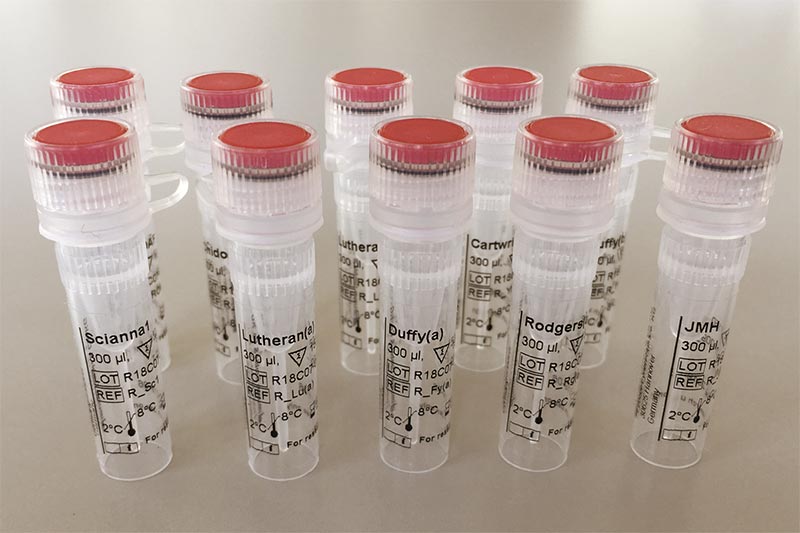
Recombinant Blood Group Antigens*
| Artikelnummer | Name | Beschreibung |
|---|---|---|
| 004 010 001 | Chido(a) | vial à 300 µl |
| 004 010 003 | CROM/DAF | vial à 300 µl |
| 004 010 004 | Dombrock(a) | vial à 300 µl |
| 004 010 005 | Dombrock(b) | vial à 300 µl |
| 004 010 006 | Duffy(a) | vial à 300 µl |
| 004 010 007 | Duffy(b) | vial à 300 µl |
| 004 010 008 | Kell-Kp(b)-Js(a) | vial à 300 µl |
| 004 010 009 | Indian(b) | vial à 300 µl |
| 004 010 010 | JMH | vial à 300 µl |
| 004 010 011 | Cellano-Kp(b)-Js(a) | vial à 300 µl |
| 004 010 014 | Landsteiner-Wiener(a) | vial à 300 µl |
| 004 010 015 | Rodgers(a) | vial à 300 µl |
| 004 010 016 | Scianna1 | vial à 300 µl |
| 004 010 017 | Xg(a) | vial à 300 µl |
| 004 010 018 | Cartwright(a) | vial à 300 µl |
| 004 010 019 | rBGA Kn(a)/DACY | vial à 300 µl |
| 004 010 020 | rBGA YCAD | vial à 300 µl |
| 004 010 021 | Lutheran(a)/Au(a) | vial à 300 µl |
| 004 010 022 | Lutheran(b)/Au(b) | vial à 300 µl |
* serological tested antigens – all relevant antigens on recombinant proteins are listed in the IFU
Publikationen